 Zagros Human Rights Center NGO with consultative status with ECOSOC

Report of the Side Event
Human Rights in Syria: Focus on Minorities and Accountability
Palais des Nations, Geneva – Room XI
Friday, 26 September 2025 | 12:00–13:00
Introduction
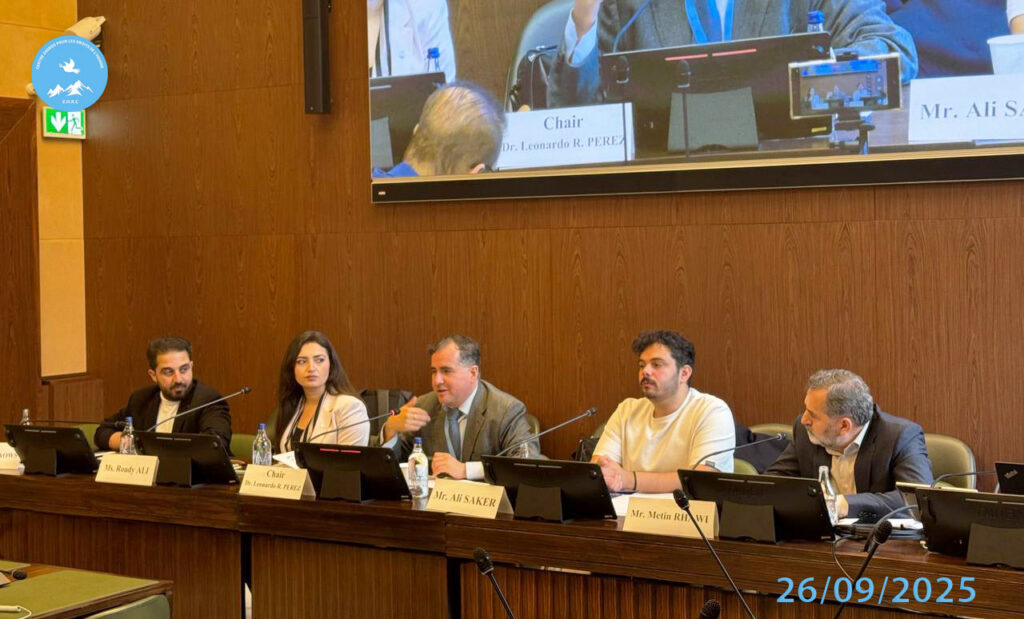
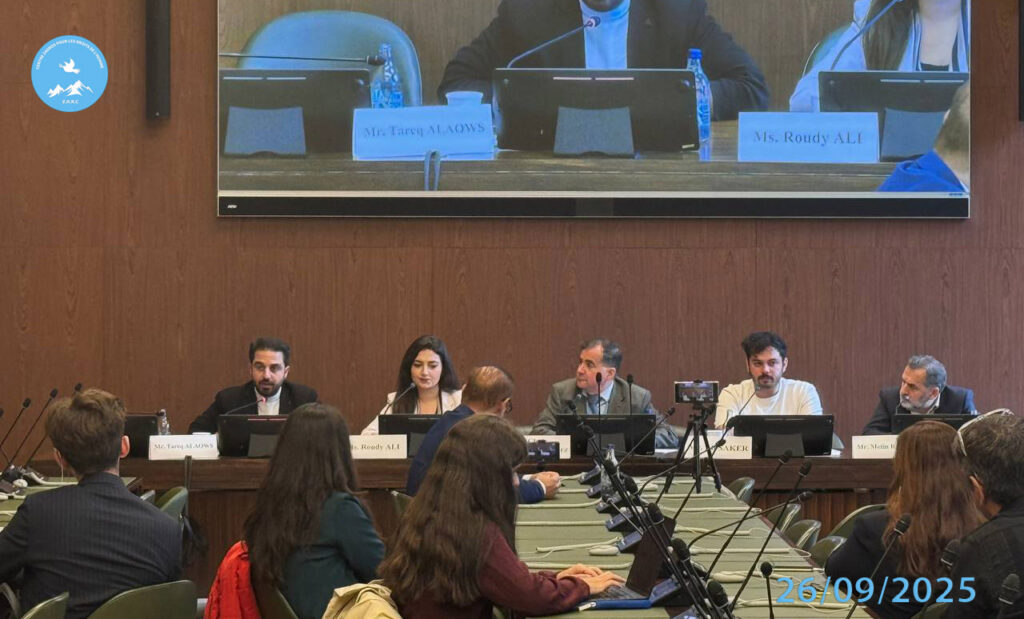
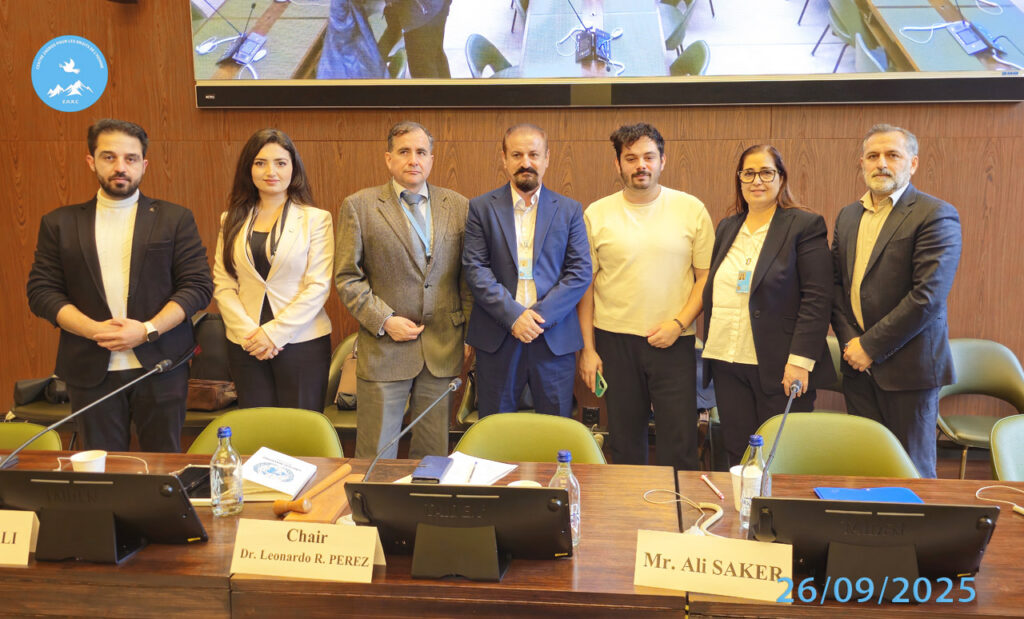
On 26 September 2025, during the 60th session of the United Nations Human Rights Council, the Centre Zagros pour les Droits de l’Homme (Zagros Human Rights Center), in collaboration with Maloca International and Solidarity International for Peace, held a moving side event entitled “Human Rights in Syria: Focus on Minorities and Accountability.”
The event gathered activists, researchers, and community representatives who have lived or documented the human cost of the Syrian conflict. Together, they sought to shed light on the suffering of minorities — Alawite, Kurdish, Christian, and Druze — and to remind the international community that behind every statistic lies a life, a family, a story.
The discussion was both emotional and urgent. As one participant noted, “the war may have changed its form, but the suffering of the people has not stopped.”
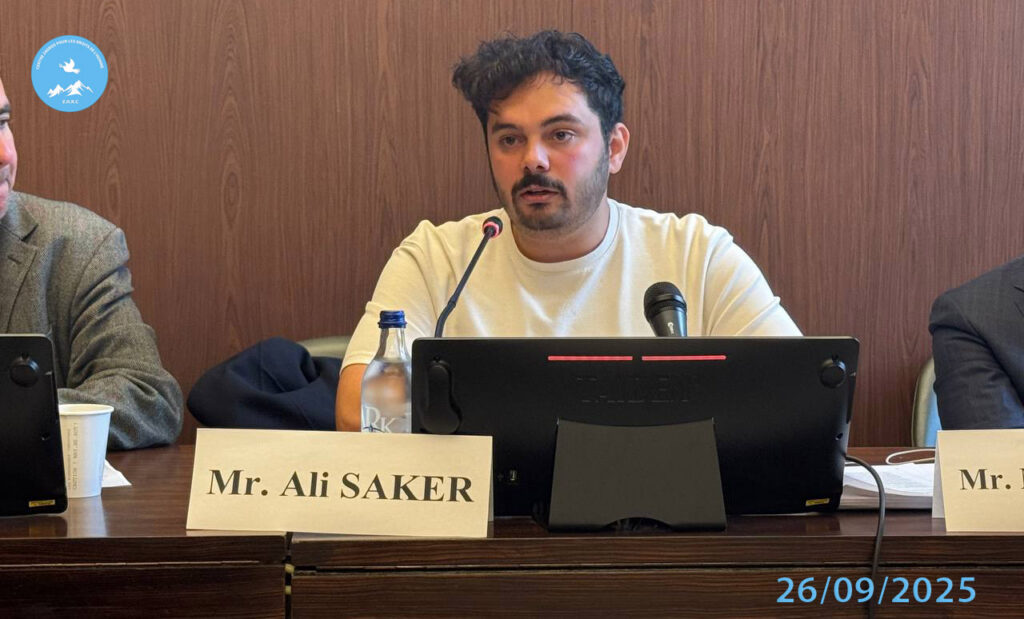
Opening Remarks – Mr. Ali Saker (Syrian Human Rights Activist)
Mr. Ali Saker opened the session with a heartfelt account of what life has become for many Alawites in Syria’s coastal regions. He described the sense of betrayal felt by communities who, after decades of conflict, had hoped for peace but found themselves trapped in a new wave of revenge and violence.
Drawing from recent investigations by Human Rights Watch, Amnesty International, and the UN Commission of Inquiry, Mr. Saker spoke of mass executions, destruction of homes and hospitals, and the silencing of local voices. Between March and July 2025, more than 1,400 civilians lost their lives in what he described as “a campaign of collective punishment disguised as liberation.”
He warned that the absence of justice was allowing old wounds to deepen and hatred to fester. His message was clear:
“The Syrian coast stands as a warning: without justice, the cycle of violence will never end.”
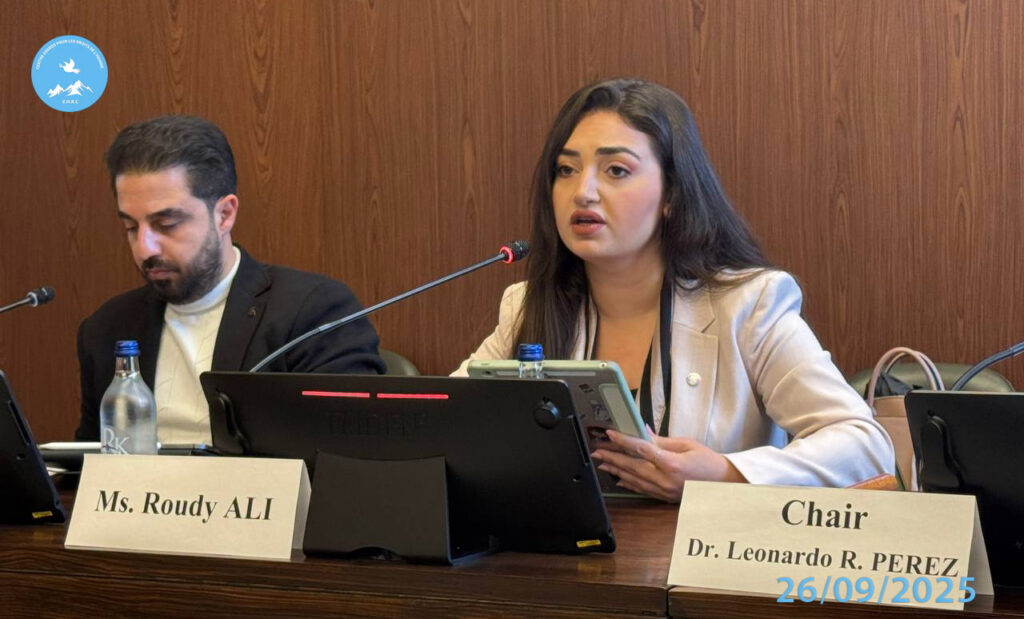
Speech – Ms. Roudy Ali (Kurdish Journalist and Women’s Rights Advocate)
Ms. Roudy Ali’s intervention was one of the most emotional moments of the event. Her speech was dedicated to the Kurdish women who vanished without a trace, and to the girls who were never allowed to return to school.
She presented evidence of arbitrary detention, property confiscation, and sexual violence perpetrated against Kurdish families, particularly in Turkish-controlled areas. Drawing from reports by Amnesty International, Human Rights Watch, and the Syrian Network for Human Rights, she exposed how militias had turned occupation into a form of organized looting.
She also spoke about the collapse of women’s rights — the closure of feminist organizations, the imposition of dress codes, and the alarming rate of child marriage (46% among Syrian refugee girls).
Her voice broke when she quoted a mother from Afrin: “They took my daughter because she refused to cover her face. I don’t know where she is now.”
Ms. Ali called for a global response that restores dignity and hope:
• Independent investigations into gender-based crimes,
• Inclusion of Kurdish and women’s representatives in peace and justice processes,
• Immediate humanitarian access for medical and psychological support,
• And education programs promoting equality and coexistence.
“Without justice, there will be no peace. Without peace, there will be no future.”
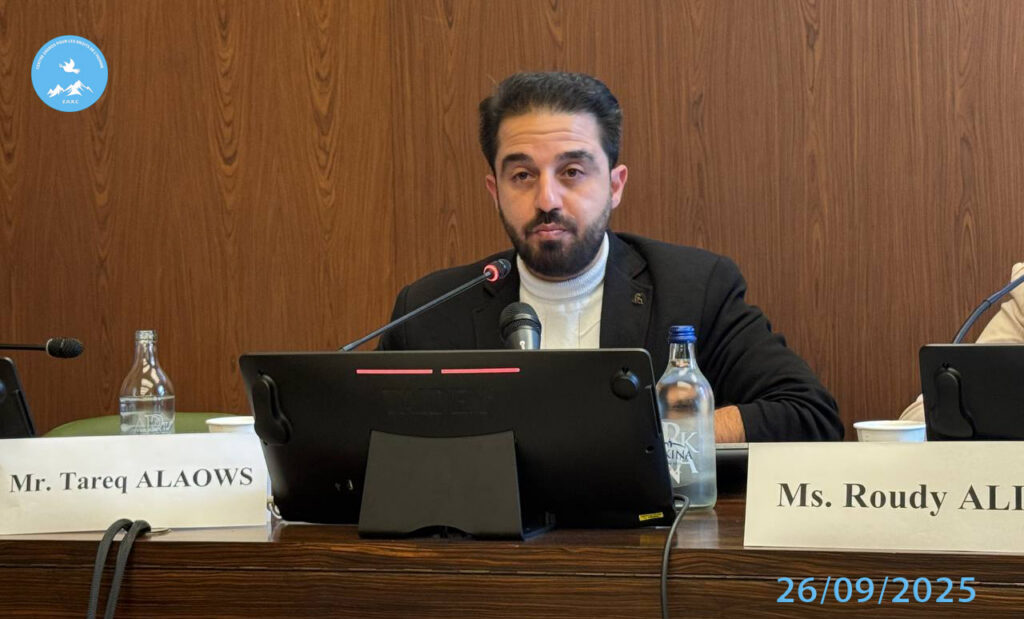
Testimony – Mr. Tareq Alaows (Syrian Human Rights and)
Mr. Tareq Alaows shared a deeply distressing testimony via video, focusing on the persecution of Druze and Jewish minorities since the fall of the Assad regime. His words painted a picture of systematic brutality and human despair.
He spoke of massacres that began in March 2025 — 46 civilians executed, 36 villages destroyed, and over 191,000 people displaced. Beyond the numbers were the names: Shahira Trudy, who died for lack of cancer medicine, and Husama Alhmed, who died when insulin ran out. “They were not killed by bombs,” he said, “but by the silence of the world.”
Citing reports from MSC International and the UN Human Rights Experts, he denounced a campaign of humiliation and terror — mock executions, sexual violence, and sectarian insults — carried out by forces linked to the interim authorities.
Mr. Alaows urged for an immediate and principled response:
• To open humanitarian corridors independent from political control,
• To launch international investigations under international law,
• And to support local community structures that protect civilians.
“The survival and dignity of Syria’s minorities depend on immediate, coordinated global action,” he concluded.
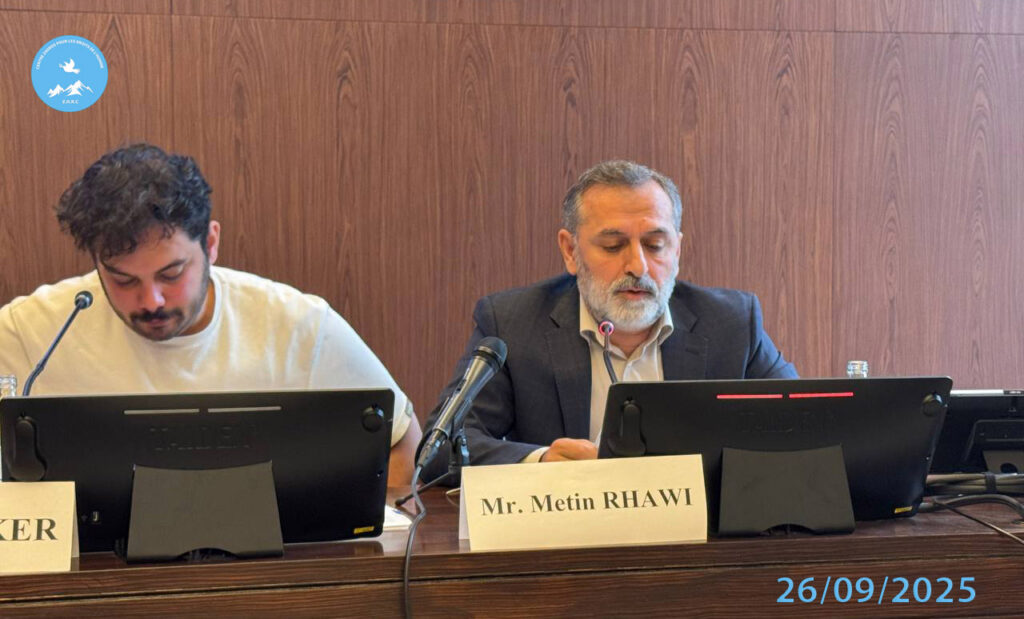
Statement – Mr. Metin Rhawi (Christian Minority Human Rights Activist and Head of Foreign Affairs, European Syriac Union (ESU))
Representing Syria’s Christian community, Mr. Metin Rhawi offered a historical and deeply reflective perspective. He spoke of a century of persecution and displacement, yet also of a culture that refuses to disappear.
While acknowledging efforts by the Autonomous Administration of North and East Syria to promote coexistence, he described the continued targeting of Christians and their institutions. He recalled the Mar Eliyas Church massacre, where 26 worshippers were killed during prayer — an attack he described as “not only against a religion, but against the idea of Syria itself.”
His message centered on survival through recognition and protection. He called for:
• Constitutional recognition of minorities,
• A decentralized and democratic system,
• Protection of cultural and religious heritage,
• And international oversight during the transition process.
“We are not asking for privilege — we are asking for survival. Without protection, Syria will lose its soul.”
Common Findings
Each speaker, from their own community’s perspective, delivered the same message:
the suffering in Syria continues, and minorities remain unprotected.
Across testimonies, several patterns emerged:
• Violence persists under new authorities, taking on sectarian and gendered forms;
• Civil infrastructure and medical systems have collapsed;
• Displacement and hunger are rising;
• And impunity remains the rule, not the exception.
Despite this, the event revealed extraordinary resilience, solidarity, and courage among minority groups who continue to organize schools, clinics, and councils under impossible conditions.
Recommendations
Participants agreed on a set of urgent and coordinated actions:
1. Establish international investigations into crimes against minorities and women.
2. Guarantee humanitarian access through neutral corridors.
3. Support local governance and civil initiatives maintaining peace and social cohesion.
4. Ensure the political participation of minorities and women in all transitional mechanisms.
5. Promote education for coexistence, countering hate and sectarian division.