 Zagros Human Rights Center NGO with consultative status with ECOSOC

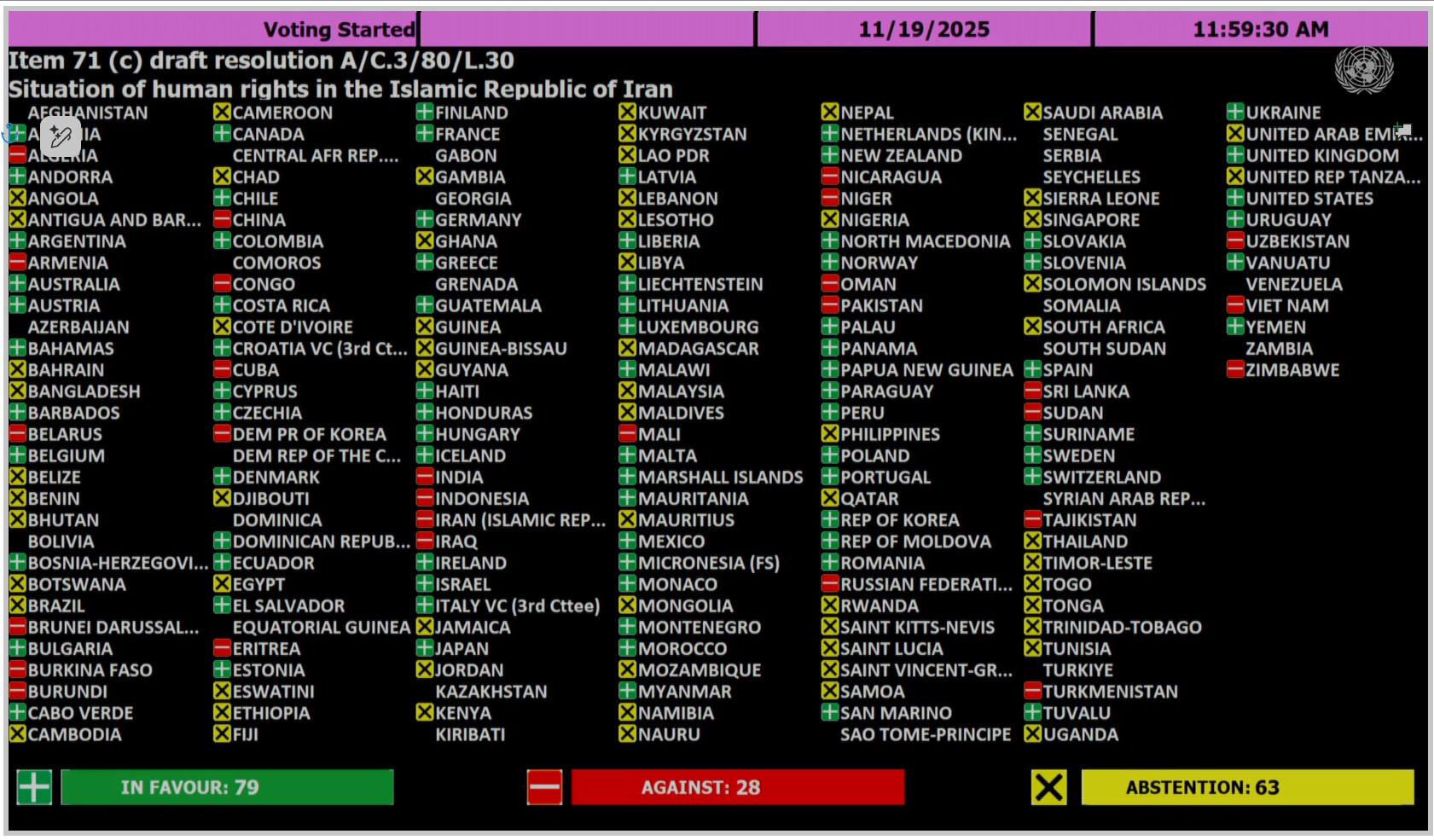
The Third Committee of the United Nations General Assembly adopted, on 19 November 2025, resolution A/C.3/80/L.30 on the human rights situation in the Islamic Republic of Iran. The draft, introduced by Canada and carrying no programme budget implications, was approved by 79 votes in favour, 28 against and 63 abstentions, reflecting continued international concern over serious and systematic violations documented in the country.
Drawing on reports from the Secretary-General, the Special Rapporteur and the Independent International Fact-Finding Mission, the resolution condemns the alarming increase in the use of the death penalty, including against protesters, women, and members of Kurdish, Baluch and Arab minorities. It highlights the use of forced confessions, unfair trials, secret executions and the execution of juvenile offenders. The text urges Iran to end public executions and to establish a moratorium as a step toward abolition.
The resolution also expresses deep concern over arbitrary detentions, torture, sexual violence in detention, enforced disappearances and degrading prison conditions, including lack of medical care, hygiene and safe drinking water. It calls on Iran to guarantee prompt access to legal counsel, to conduct independent investigations into abuses, and to comply with the Vienna Convention on Consular Relations.
The rights of women and girls feature prominently in the text. The resolution denounces repression linked to the compulsory hijab, administrative and criminal sanctions, digital surveillance, and restrictions on social, economic and political participation. It urges Iran to adopt comprehensive legislation against domestic violence, eliminate early and forced marriages, and remove gender-based restrictions.
The crackdown on protests, particularly those of 2022, is strongly condemned. The resolution highlights the use of lethal force, mass arrests, reprisals against families, journalists, lawyers and human rights defenders, as well as Internet shutdowns and restrictive cyber legislation.
During the session, Iran rejected the resolution, calling it “politically motivated and lacking legitimacy,” and claiming it ignored the impact of sanctions and “attacks by Israel and the United States.” Despite these objections, the strong majority vote confirms the sustained international focus on Iran’s human rights situation, consistent with previous years (80-27-68 in 2024 and 79-28-62 in 2023).
The adoption of resolution A/C.3/80/L.30 therefore reaffirms the determination of UN Member States to maintain diplomatic pressure on the Iranian authorities and to demand concrete reforms to protect the fundamental rights of all individuals in the Islamic Republic of Iran.
You will find the full text of the resolution below :
…………………………………………………………

United Nations — A/C.3/80/L.30
General Assembly
Distr.: Limited
4 November 2025
Original: English
25-17789 (E) 111125 — 25-17789
Eightieth session — Third Committee
Agenda item 71 (c)
Promotion and protection of human rights: human rights situations and reports of special rapporteurs and representatives
Albania, Andorra, Austria, Belgium, Bulgaria, Canada, Croatia, Estonia, Finland, France, Germany, Iceland, Ireland, Israel, Latvia, Liechtenstein, Lithuania, Luxembourg, Malta, Montenegro, Netherlands (Kingdom of the), New Zealand, Norway, Poland, Romania, Slovakia, Slovenia, Spain, Sweden, Ukraine and United Kingdom of Great Britain and Northern Ireland: draft resolution
Situation of human rights in the Islamic Republic of Iran
The General Assembly,
Guided by the Charter of the United Nations, as well as the Universal Declaration of Human Rights,¹ the International Covenants on Human Rights² and other international human rights instruments,
Recalling its previous resolutions on the situation of human rights in the Islamic Republic of Iran, the most recent of which is resolution 79/183 of 17 December 2024,
Welcoming Human Rights Council resolution 58/21 of 3 April 2025,³ in which the Council decided to extend the mandates of the Independent International Fact-Finding Mission on the Islamic Republic of Iran⁴ and of the Special Rapporteur⁵ on the situation of human rights in the Islamic Republic of Iran for a period of one year,
- Welcomes the report of the Secretary-General submitted pursuant to resolution 79/183,⁶ the report of the Independent International Fact-Finding Mission on the Islamic Republic of Iran submitted pursuant to Human Rights Council resolution 55/19⁷ and the report of the Special Rapporteur on the situation of human rights in the Islamic Republic of Iran, submitted pursuant to Human Rights Council resolution 58/21⁸;
- Notes the engagement by the Islamic Republic of Iran with human rights treaty bodies, including the submission of periodic reports to the Committee on the Elimination of Racial Discrimination and participation in the Committee’s review in August 2024, as well as its participation in the fourth cycle of the universal periodic review of the Human Rights Council;
- Welcomes the establishment of the technical cooperation framework in September 2024 between the Islamic Republic of Iran and the Office of the United Nations High Commissioner for Human Rights, and notes constructive engagement with the Office on substantive issues;
- Recognizes engagement by the Islamic Republic of Iran with select special procedure mandate holders, while noting the limited scope of such cooperation to date and reaffirming the importance of substantive engagement and full and unhindered cooperation, including access to the country, notably for the Special Rapporteur on the situation of human rights in the Islamic Republic of Iran and the Independent International Fact-Finding Mission on the Islamic Republic of Iran;
- Notes the efforts of the Islamic Republic of Iran in hosting one of the largest refugee populations in the world, including approximately 3.49 million refugees, asylum-seekers and Afghans in protracted refugee-like situations according to figures reported by the Office of the United Nations High Commissioner for Refugees, acknowledges efforts to provide them with access to basic services, in particular healthcare, temporary work permits and education for children, while also expressing serious concern about the withdrawal of temporary legal protections for Afghan refugees in the Islamic Republic of Iran, threats to their human rights, notably the human rights of Afghan women and girls, and increased limitation of basic services to undocumented Afghans, as well as the large-scale return and forced return of more than 1.65 million Afghans from the Islamic Republic of Iran in 2025, including those with valid documentation and unaccompanied children, putting returnees at serious risk of persecution, including torture or killing, especially women and girls who face acute challenges and are deprived of their full enjoyment of human rights due to the policies of the Taliban, and emphasizes that the removal must be conducted in accordance with international law and humanitarian standards, ensuring the dignity, safety and rights of those affected;
- Also notes the readiness of the Iranian High Council for Human Rights and other Iranian officials to engage in bilateral dialogues on human rights, and calls upon them to increase such dialogues or resume those that have been paused;
- Condemns in the strongest terms the alarming and significant increase in and the sustained and extensive use of the application of the death penalty by the Islamic Republic of Iran, in violation of its international obligations, including executions undertaken against persons on the basis of forced confessions, without fair trial and due process, and in secrecy or without prior notification to the prisoner’s family or legal counsel, which can lead to irreversible miscarriages of justice; reiterates the concern that a significant number of offences carrying the death penalty do not qualify as the most serious crimes, including drug-related offences, as well as other actions provided under the penal code of the Islamic Republic of Iran, including adultery, same-sex relations, apostasy, blasphemy and convictions for drinking alcohol, as well as crimes that are overly broad or vaguely defined,⁹ which is in violation of the International Covenant on Civil and Political Rights; expresses serious concern at the disproportionate application of the death penalty to persons belonging to minorities, particularly ethnic and religious minorities, who are targeted for death sentences relating to their alleged involvement in political or religious groups, and at the increased execution of women; expresses concern at the use of the death penalty by the Islamic Republic of Iran as a tool of political repression and silencing against dissidents, opponents and participants in protests, including against those exercising their rights to freedom of opinion and expression and peaceful assembly; expresses further concern at the continuing disregard for protections under Iranian law or internationally recognized safeguards relating to the imposition of the death penalty; calls upon the Government of the Islamic Republic of Iran to return the remains of those executed to their families to allow for proper burial and to make publicly available disaggregated data on the use of the death penalty, including data on the characteristics of convicted and executed persons and on the offences of which they were convicted, and calls upon the Government of the Islamic Republic of Iran to abolish, in law and in practice, public executions and to consider establishing a moratorium on executions;
- Expresses serious concern about the continued imposition of the death penalty by the Islamic Republic of Iran against minors, and urges the Islamic Republic of Iran to cease the imposition of the death penalty against persons who, at the time of their alleged offence, were under the age of 18, in violation of the International Covenant on Civil and Political Rights and the Convention on the Rights of the Child,¹¹ and to commute the sentences for all child offenders on death row;
- Calls upon the Islamic Republic of Iran to ensure, in law and in practice, that no one is subjected to torture or other cruel, inhuman or degrading treatment or punishment, which may include sexual and gender-based violence in all its forms, amputations and punishments that are grossly disproportionate to the nature of the offence, in conformity with the constitutional guarantees of the Islamic Republic of Iran and international obligations and standards, including but not limited to the United Nations Standard Minimum Rules for the Treatment of Prisoners (the Nelson Mandela Rules),¹² and to ensure that all allegations of torture or other cruel, inhuman or degrading treatment or punishment are promptly and impartially investigated and perpetrators held accountable in line with international law;
- Urges the Islamic Republic of Iran to cease the widespread and systematic use of arbitrary arrests and detention, including the frequent use of this practice to target dual and foreign nationals, who, in some cases, reside overseas and may be prosecuted upon return, and the practices of enforced disappearance and incommunicado detention for similar purposes, to release those who have been arbitrarily detained and to account for the fate or whereabouts of those subjected to enforced disappearance and to hold those responsible to account, and to uphold, in law and in practice, procedural guarantees and other legal protections to ensure a fair trial, including timely access to legal representation of one’s choice from the time of arrest through all stages of trials and appeals, full access to the content of the case file, being informed promptly and in detail, in a language that the accused speaks and understands, of the charges faced, and being provided consideration of bail and other reasonable terms for release from custody pending trial, and respect the prohibition of torture and other cruel, inhuman or degrading treatment or punishment, and calls upon the Islamic Republic of Iran to ensure that it meets its obligations under article 36 of the Vienna Convention on Consular Relations¹³ in relation to communication with and access to nationals of sending States who are in prison, custody or detention;
- Calls upon the Islamic Republic of Iran to address the poor conditions in prisons, including overcrowding, unsanitary conditions and the lack of adequate food and clean water, expresses concern about the detention of children with their mothers in deteriorating conditions, urges an end to the practice of deliberately denying prisoners access to adequate and timely medical treatment and supplies, safe drinking water, sanitation and hygiene, contact with family members, or making such access contingent upon confession or subject to reprisal, as well as the use of sexual and gender-based violence, including rape, against prisoners, and calls upon the Islamic Republic of Iran to disclose the fate and whereabouts of all prisoners and to establish credible and independent prison oversight authorities to investigate all deaths in detention, including during transport and hospital admission, and all complaints or allegations of abuse or human rights violations, and to ensure that investigations are prompt, effective, independent, transparent and impartial in line with international law and to ensure accountability;
- Condemns the targeted repression of women and girls by the Islamic Republic of Iran, both online and offline, and the lack of accountability and justice measures for human rights violations perpetrated against women and girls, and strongly urges the Islamic Republic of Iran to eliminate, in law and in practice, all forms of systemic discrimination and violence against women and girls, in public and private life, including sexual and gender-based violence, verbal and physical harassment, and related human rights violations against women and girls, and to ensure that grievances are taken seriously and investigations into alleged human rights violations and abuses are conducted promptly, effectively, independently, transparently and impartially in conformity with international law;
- Notes the withdrawal and subsequent reversal of withdrawal of the bill to protect the dignity and security of women against violence, calls for the development and implementation of comprehensive domestic violence legislation that effectively criminalizes violence against women and girls and ensures effective protection and remedies for victims, and calls for the Islamic Republic of Iran to take gender-responsive measures, in policy and in practice, to prevent and ensure protection for women and girls against sexual and gender-based violence in all its forms, including sexual assault and intimate partner violence, to ensure women’s and girls’ equal protection and access to justice, including by preventing and prohibiting femicide, so-called honour killings, female genital mutilation, which persists in some minority communities, and child, early and forced marriage, which is inherently destructive to the life of the girl child and has increased in the Islamic Republic of Iran in recent years;
- Calls upon the Islamic Republic of Iran to promote, support and enable women’s and girls’ full, equal and meaningful participation and leadership in political and other decision-making processes, while noting incremental steps in the political participation of women and recognizing the high enrolment of girls and women in all levels of education in the Islamic Republic of Iran, to ensure women’s and girls’ equal access to free, equitable primary and secondary education and equal access to higher education, and to take appropriate prevention and protection measures to protect schools and students, including girls, and remove legal, regulatory and cultural barriers to women’s free, equal and meaningful participation and leadership in the labour market and in all aspects of economic, cultural, social and political life, including unrestricted participation in and attendance at sporting events, and expresses grave concern that the Law on Youthful Population and Protection of the Family undermines the exercise of the right to the enjoyment of the highest attainable standard of physical and mental health for women and girls;
- Notes the temporary suspension of the Law on Protecting the Family through the Promotion of the Culture of Chastity and Hijab, expresses serious concern regarding its potential future implementation, including its enforcement of compliance online and offline and criminal, administrative and financial consequences for non-compliance, including fines, job dismissal, travel bans, the confiscation of assets and restricted access to education and healthcare, and regarding the law’s prescription of the use of severe penalties such as imprisonment, flogging and the death penalty for individuals accused of challenging hijab regulation; also expresses serious concern at ongoing forced compliance and surveillance of compulsory veiling laws and policies, including harassment of women and girls for non-compliance, and the use of facial recognition and surveillance technologies at universities, resulting in denial of entry, withdrawal from courses and expulsion for non-compliance and human rights activism, further expresses serious concern that such discriminatory compulsory veiling laws and policies fundamentally undermine the enjoyment of human rights by women and girls, inter alia their rights to freedom of religion or belief, opinion and expression and freedom of movement, as well as economic, social and cultural rights, and reaffirms the call for the Government of the Islamic Republic of Iran to permanently repeal all such laws and policies;
- Expresses serious concern at the widespread restrictions on the rights to freedom of peaceful assembly and association and freedom of opinion and expression, both online and offline, and calls upon the Islamic Republic of Iran to immediately and unconditionally release persons arbitrarily detained for the exercise of their human rights and fundamental freedoms, including human rights defenders, journalists and all those who remain under detention for taking part in peaceful protests;
- Condemns the measures used by the Islamic Republic of Iran to repress protests, including the protests that began in September 2022, notably the use of the death penalty against those connected to the protests, arbitrary detention, disproportionate force, including the use of force resulting in death and injury, torture and other cruel, inhuman or degrading treatment or punishment during arrest and throughout detention, physical violence and psychological abuse in detention, including sexual and gender-based violence, and judicial and other forms of harassment of human rights defenders and those associated with the protests, including repression online, calls upon the Islamic Republic of Iran to uphold the human rights of those involved in protests and to rescind unduly harsh sentences, including those involving the death penalty and long-term internal exile, emphasizes commitments made by judicial authorities to review cases of those arrested, also calls upon the Islamic Republic of Iran to end reprisals against human rights defenders, wherever they may occur, including reprisals against women human rights defenders, children, the families of protesters, journalists and other media workers covering protests, lawyers who represent or seek to represent protesters, and those who cooperate or attempt to cooperate with the United Nations human rights mechanisms, and re-emphasizes the importance of prompt, independent, impartial, effective and transparent investigations into all instances of human rights violations and of holding those responsible to account to ensure justice and an end to the Islamic Republic of Iran’s impunity for violations;
- Urges the Government of the Islamic Republic of Iran to address violations of the rights to social security and to just and favourable conditions of work, to address wage arrears, denial of employee protections and benefits, unjustified dismissals and low worker wages, and to increase wages and pensions to ensure an adequate living standard;
- Strongly urges the Islamic Republic of Iran to end violations of the rights to freedom of opinion and expression, both online and offline, which includes the freedom to seek, receive and impart information, and the rights to freedom of peaceful assembly and freedom of association, including through Internet disruption practices such as full and partial Internet shutdowns, blocking of social media platforms and applications, shutting down networks and throttling access to the Internet, applications and services on mobile data, online censorship to intentionally prevent or disrupt access to or the dissemination of information online, acknowledges the lifting of the ban on access to specific platforms as a positive step, while expressing concern over existing measures restricting access online, the use of digital technologies to harass and delegitimize the work of human rights defenders, arbitrary or unlawful surveillance of online and digital contexts, and other widespread restrictions on Internet access or dissemination of information online, and calls upon the Islamic Republic of Iran to withdraw the bill on protecting the rights of users in cyberspace as its implementation undermines the rights and fundamental freedoms of individuals online;
- Expresses concern about the renewed efforts by the Islamic Republic of Iran to limit access to information, criminalize dissent and the sharing of information, both online and offline, and increase repression through espionage-related charges imposed without due process, fair trial guarantees, and/or otherwise in violation of international human rights law, including through the use of arbitrary arrest and detention, also expresses concern about the Law on Strengthening the Penalty for Espionage and Cooperation with the Zionist Regime and Hostile States, including its expansion of the scope of conduct considered to be espionage, and the expansion of offences punishable by long-term imprisonment and execution, further expresses concern regarding provisions that would allow for its retroactive application, contrary to the International Covenant on Civil and Political Rights, and calls for its immediate repeal;
- Expresses grave concern about repressive activities conducted by the Islamic Republic of Iran to harm, silence and intimidate individuals who oppose the Government of the Islamic Republic of Iran and who bring attention to human rights violations, including human rights defenders, journalists, dissidents and their families, who, in some cases, are targeted overseas by transnational repression, including through digital, physical and other means, such as the targeting of family members inside the Islamic Republic of Iran through surveillance, harassment and intimidation as a means to silence those abroad, and expresses serious concern at the harassment and intimidation of victims, survivors and family members who seek accountability for human rights violations, including in relation to long-standing human rights violations such as enforced disappearances, and in relation to the 2022 protests;
- Encourages the Government of the Islamic Republic of Iran to cooperate with all relevant authorities on investigations into allegations of harassment and intimidation of some families of the victims of the downing of Ukraine International Airlines flight 752, and calls upon the Government to ensure accountability for the downing in accordance with its obligations under applicable international law;
- Reiterates its call upon the Islamic Republic of Iran, including the judicial and security branches, to create and maintain, in law and in practice, a safe and enabling environment, both online and offline, in which an independent, diverse and pluralistic civil society can operate free from hindrance, insecurity and reprisals, to end its harassment, intimidation and persecution, including abductions, arrests and executions, of all individuals, including but not limited to political opponents, human rights defenders and their families, whether they be Iranians, dual nationals or foreign nationals, and wherever it may occur, expresses concern at instances of repression of journalists, media workers and their families in the Islamic Republic of Iran who face harassment, arbitrary detention and lengthy prison sentences, and urges the Government of the Islamic Republic of Iran to halt threats and intimidation against journalists and media workers who are critical of the Government, either inside or outside of the Islamic Republic of Iran, and to investigate and prosecute those responsible for reprisals;
- Calls upon the Islamic Republic of Iran to release women human rights defenders imprisoned for exercising their rights, including the rights to freedom of peaceful assembly, freedom of association and freedom of opinion and expression, and to recognize the risks, violence and persecution experienced by women human rights defenders and take appropriate, robust and practical steps to protect women human rights defenders and guarantee their full enjoyment of all their human rights;
- Recalls the positive, important and legitimate role of human rights defenders in all sectors, including women human rights defenders, in addition to lawyers, journalists, media workers, writers, artists and cultural practitioners in promoting and protecting human rights and strengthening understanding, tolerance and peace, and strongly urges the Islamic Republic of Iran to create and support a safe, enabling, accessible and inclusive environment online and offline for their participation in all relevant activities;
- Calls upon the Islamic Republic of Iran to eliminate, in law and in practice, all forms of discrimination and other human rights violations against persons belonging to ethnic, linguistic or other minorities, including but not limited to Ahwazi Arabs, Azerbaijani Turks, Baluchis and Kurds, and their defenders, and expresses particular concern at the higher proportion of casualties among protesters in minority-populated cities and provinces, and at the disproportionate imposition of the death penalty on persons belonging to minorities, in particular the Baluchi, Kurdish and Arab minorities, as well as a concerning rise in the number of Afghans executed;
- Expresses serious concern about ongoing severe limitations and increasing restrictions on the right to freedom of thought, conscience, religion or belief, restrictions on the establishment of places of worship, undue restrictions on burials carried out in accordance with religious tenets, attacks against places of worship and burial, as well as any other restrictions or attacks involving human rights violations or abuses, including but not limited to those involving the increased harassment, intimidation, persecution, arbitrary arrest and detention of, and incitement to hatred that can lead to violence against, persons belonging to recognized and unrecognized religious minorities, including Christians (particularly converts from Islam), Gonabadi Dervishes, Jews, Sufi Muslims, Sunni Muslims, Yarsanis, Zoroastrians and, in particular, Baha’is, who have been subjected to a continued increase in and the cumulative impacts of long-standing persecution, including attacks, harassment and targeting, with women and girls in these communities facing particular risk, and who face increasing restrictions and systemic persecution by the Government of the Islamic Republic of Iran on account of their faith and have been reportedly subjected to enforced disappearances, mass and arbitrary arrests without due process and fair trial guarantees, as well as the disproportionate or discriminatory imposition of the death penalty and lengthy prison sentences, as well as the arrest of prominent and elderly members and the increased confiscation and destruction of property, and calls upon the Government to cease monitoring individuals on account of their religious identity, to release all religious practitioners imprisoned for their membership in or activities on behalf of a minority religious group, to cease the desecration of cemeteries and to ensure that everyone has the right to freedom of thought, conscience and religion or belief, including the freedom to have, to change or to adopt a religion or belief of their choice, in accordance with its obligations under the International Covenant on Civil and Political Rights;
- Calls upon the Islamic Republic of Iran to eliminate, in law and in practice, all forms of discrimination on the basis of thought, conscience, religion or belief, including restrictions contained in article 499 bis and article 500 bis of the Islamic Penal Code, the continuing enforcement of which has significantly escalated discrimination and violence, as well as economic restrictions, such as the closure, destruction or confiscation of businesses, land and properties, the cancellation of licences and the denial of employment in certain public and private sectors, including government or military positions and elected office, the denial of and restrictions on access to education, including for members of the Baha’i and other religious minorities, and other acts involving human rights violations or abuses against persons belonging to recognized and unrecognized religious minorities, condemns without reservation heightened antisemitism, the targeted attacks on Jewish communities and any denial of the Holocaust, and calls upon the Islamic Republic of Iran to end ongoing systemic impunity for those who commit crimes against persons belonging to recognized and unrecognized religious minorities;
- Expresses serious concern at the lack of accountability of the Government of the Islamic Republic of Iran in response to long-standing human rights violations involving the Iranian judiciary and security agencies, including ongoing enforced disappearances, extrajudicial executions and the destruction of evidence and grave sites, whereby the lack of accountability of authorities enables the potential for violations to reoccur and persist, as well as ongoing systemic impunity for human rights violations, and expresses concern about reports of incitement to discrimination, hostility and violence in State-linked Persian and Arabic media outlets, echoing the 1988 reported summary and arbitrary executions;
- Expresses particular concern at the failure of the Islamic Republic of Iran to conduct prompt, effective, independent, transparent and impartial investigations that align with international standards in response to all allegations of human rights violations, including disproportionate use of force, arbitrary arrest and detention, and torture and other cruel, inhuman or degrading treatment or punishment, including sexual and gender-based violence, and the failure to respect fair trial guarantees and due process, and the use of torture, including to extract confessions, and enforced disappearances as experienced by human rights defenders, peaceful protesters, political prisoners and dual or foreign nationals, among others, and reaffirms the call for the Government of the Islamic Republic of Iran to end ongoing systemic impunity for all human rights violations, to launch a comprehensive accountability process, including legal reforms, and to ensure the availability of effective remedies for victims, survivors and all those seeking accountability, truth and justice for human rights violations;
- Calls upon the Islamic Republic of Iran to implement its obligations under those human rights treaties to which it is already a Party, to withdraw any reservations that are imprecise or could be considered incompatible with the object and purpose of the treaty, to act upon the concluding observations concerning the Islamic Republic of Iran adopted by the bodies of the international human rights treaties to which it is a Party and to consider ratifying or acceding to the international human rights treaties to which it is not already a Party;
- Also calls upon the Islamic Republic of Iran to deepen its engagement with international human rights mechanisms by:
(a) Cooperating fully with the Special Rapporteur on the situation of human rights in the Islamic Republic of Iran, including by accepting the repeated requests made by the Special Rapporteur to visit the country in order to carry out the mandate, and to take under consideration the conclusions and recommendations presented to the Government of the Islamic Republic of Iran in reports by United Nations special procedures;
(b) Cooperating fully with the Independent International Fact-Finding Mission on the Islamic Republic of Iran, including by allowing unhindered access to the country and to gather information critical to carrying out the mandate, and to take under consideration the conclusions and recommendations presented to the Government of the Islamic Republic of Iran in the Mission’s reports;
(c) Increasing cooperation with other special procedures, including by facilitating long-standing requests for access to the country from thematic special procedure mandate holders, whose access to its territory has been restricted or denied, despite the standing invitation issued by the Islamic Republic of Iran, without imposing undue conditions upon those visits;
(d) Continuing to enhance its cooperation with the treaty bodies, including by submitting reports under the International Covenant on Civil and Political Rights, the International Convention on the Elimination of All Forms of Racial Discrimination,¹⁴ the Convention on the Rights of the Child, the Convention on the Rights of Persons with Disabilities¹⁵ and the International Covenant on Economic, Social and Cultural Rights¹⁶ and the implementation of the recommendations from treaty bodies;
(e) Continuing to enhance its cooperation with all relevant United Nations bodies to improve the promotion and protection of human rights in the Islamic Republic of Iran;
(f) Implementing all accepted universal periodic review recommendations from its first cycle, in 2010, its second cycle, in 2014, its third cycle, in 2019, and its fourth cycle, in 2025, with the full and genuine participation of independent civil society and other stakeholders in the implementation process;
(g) Building upon the engagement of the Islamic Republic of Iran with the universal periodic review process by continuing to explore and deepen cooperation on human rights and justice reform with the United Nations, including the Office of the United Nations High Commissioner for Human Rights;
(h) Following through on its long-standing commitment to establish an independent national human rights institution in line with the principles relating to the status of national institutions for the promotion and protection of human rights (the Paris Principles),¹⁷ made in the context of its first, second, third and fourth universal periodic reviews by the Human Rights Council;
- Further calls upon the Islamic Republic of Iran to ensure that its national laws are consistent with its obligations under international human rights law and that they are implemented in accordance with its international obligations;
- Calls upon the Islamic Republic of Iran to address the substantive concerns highlighted in the reports of the Secretary-General, the Special Rapporteur on the situation of human rights in the Islamic Republic of Iran and the Independent International Fact-Finding Mission on the Islamic Republic of Iran, as well as the specific calls to action found in previous resolutions of the General Assembly and the Human Rights Council, and to respect fully its human rights obligations in law and in practice;
- Strongly encourages the relevant thematic special procedure mandate holders to pay particular attention to, with a view to investigating and reporting on, the human rights situation in the Islamic Republic of Iran;
- Requests the Secretary-General to report to the General Assembly at its eighty-first session on the progress made in the implementation of the present resolution, including options and recommendations to improve its implementation;
- Decides to continue its examination of the situation of human rights in the Islamic Republic of Iran at its eighty-first session under the item entitled “Promotion and protection of human rights”.
Source : https://docs.un.org/en/A/C.3/80/L.30