 Zagros Human Rights Center NGO with consultative status with ECOSOC

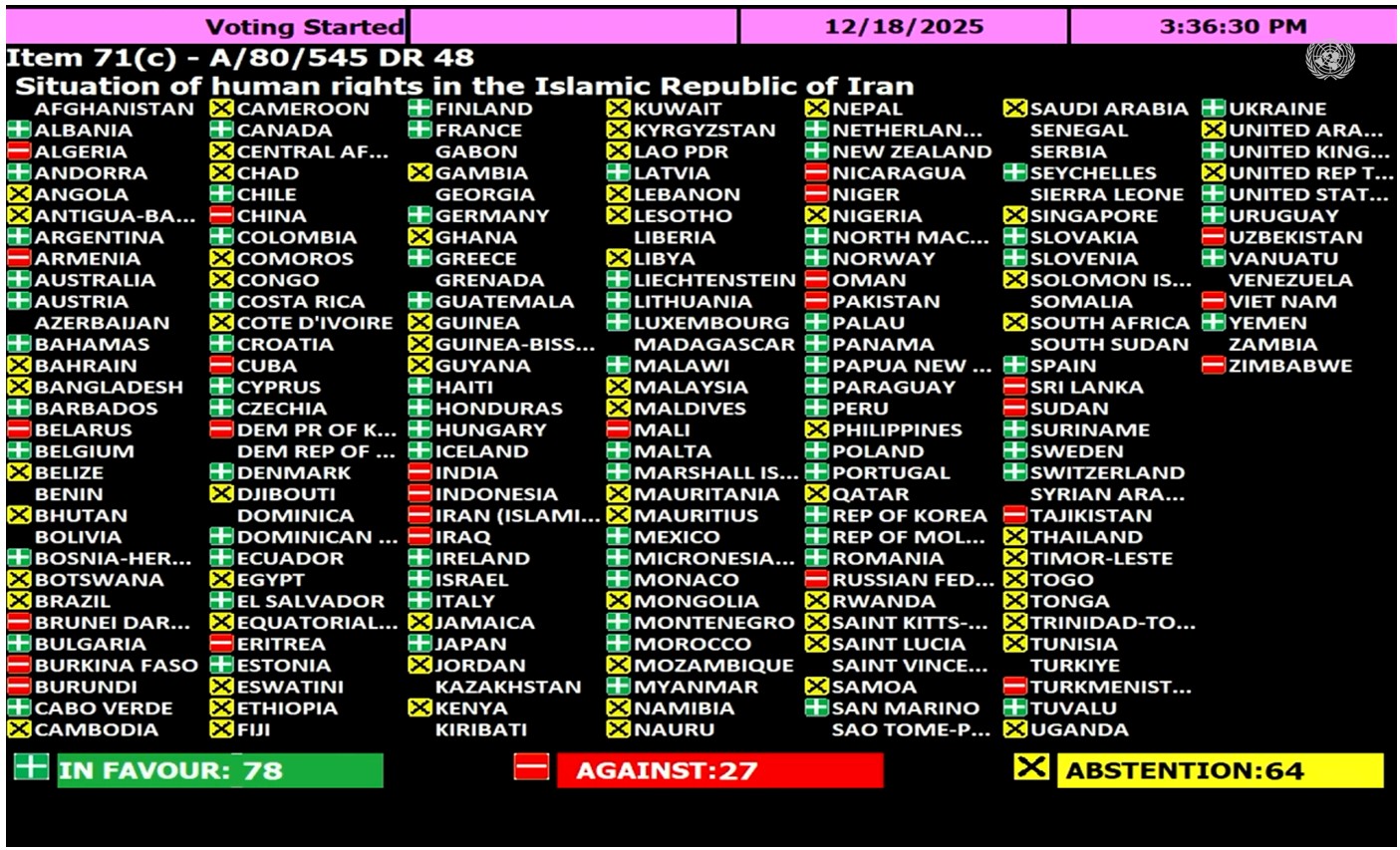
On 18 December 2025, the United Nations General Assembly once again adopted its annual resolution on the human rights situation in the Islamic Republic of Iran (A/80/545 DR 48). The resolution was adopted with 78 votes in favour, 27 against, and 64 abstentions, confirming that a clear majority of the international community continues to express concern over the human rights situation in Iran.
The final plenary vote followed the earlier adoption of the draft resolution by the Third Committee of the General Assembly on 19 November 2025, where it was approved with 79 votes in favour, 28 against, and 63 abstentions. A comparison of the two votes indicates that the changes were minimal and largely attributable to differences in attendance or absence of delegations, rather than to substantive shifts in political positions. The core message of the international community has therefore remained unchanged, reflecting sustained concern over serious human rights violations in Iran and the continued engagement of UN human rights mechanisms.
A few days prior to the plenary vote, 85 Iranian and international civil society organizations issued a joint statement addressed to the members of the General Assembly. Drawing on the UN Secretary-General’s report, the report of the Special Rapporteur on the situation of human rights in Iran, and the findings of the Independent International Fact-Finding Mission, the statement warned that widespread, systematic, and organized human rights violations in Iran may amount to crimes against humanity. The signatory organizations called for the adoption of the resolution with strengthened language, the pursuit of international accountability, and effective protection of civil society, human rights defenders, and vulnerable groups.
With regard to next steps, the adoption of the resolution is expected to contribute to the continuation and strengthening of the mandate of the Special Rapporteur, the preservation and expansion of independent documentation and evidence-gathering mechanisms, and enhanced coordination among UN human rights bodies. At the same time, discussions on avenues for international accountability — including international judicial mechanisms and the exercise of universal jurisdiction at the national level — are likely to remain on the agenda of States and civil society actors. Progress in these areas will largely depend on sustained diplomatic engagement, coherence among supporting States, and continued documentation efforts by civil society.
Taken together, the re-adoption of resolution A/80/545 DR 48, the relative stability of voting patterns, and the coordinated engagement of civil society demonstrate that the human rights situation in Iran remains firmly on the formal agenda of the United Nations General Assembly, underscoring the international community’s responsibility to move beyond expressions of concern toward effective accountability and support for victims.
Voting Breakdown on UN General Assembly Resolution A/80/545 DR 48
✅ Countries voting IN FAVOUR (78)
Afghanistan, Albania, Algeria, Andorra, Antigua and Barbuda, Argentina, Australia, Austria, Azerbaijan, Barbados, Belgium, Benin, Bolivia, Bosnia and Herzegovina, Bulgaria, Burundi, Cabo Verde, Canada, Chile, Colombia, Costa Rica, Croatia, Cyprus, Czech Republic, Denmark, Dominican Republic, Ecuador, El Salvador, Estonia, Finland, France, Georgia, Germany, Ghana, Greece, Grenada, Guatemala, Haiti, Honduras, Hungary, Iceland, Ireland, Israel, Italy, Japan, Liechtenstein, Lithuania, Luxembourg, Malawi, Malta, Mexico, Federated States of Micronesia, Monaco, Montenegro, Morocco, Mozambique, Namibia, Netherlands, New Zealand, Norway, Palau, Panama, Papua New Guinea, Paraguay, Peru, Poland, Portugal, Republic of Korea, Republic of Moldova, Romania, San Marino, Seychelles, Slovenia, Spain, Sweden, Switzerland, Ukraine, United Kingdom, United States of America, Uruguay, Vanuatu, Yemen.
❌ Countries voting AGAINST (27)
Armenia, Belarus, Brunei Darussalam, Cuba, Democratic People’s Republic of Korea, Eritrea, India, Indonesia, Iran, Iraq, Mali, Nicaragua, Niger, Oman, Pakistan, Russian Federation, Sri Lanka, Sudan, Syrian Arab Republic, Tajikistan, Thailand, Türkiye, Turkmenistan, Uzbekistan, Venezuela, Viet Nam, Zimbabwe.
⚪ Countries ABSTAINING (64)
Angola, Bahamas, Bahrain, Bangladesh, Belize, Bhutan, Botswana, Brazil, Burkina Faso, Cambodia, Cameroon, Central African Republic, Chad, China, Comoros, Congo, Côte d’Ivoire, Djibouti, Dominica, Egypt, Equatorial Guinea, Eswatini, Ethiopia, Fiji, Gabon, Gambia, Guinea, Guinea-Bissau, Guyana, Jamaica, Jordan, Kazakhstan, Kenya, Kiribati, Kuwait, Kyrgyzstan, Lao PDR, Lebanon, Lesotho, Liberia, Libya, Madagascar, Malaysia, Maldives, Marshall Islands, Mauritania, Mauritius, Mongolia, Myanmar, Nauru, Nepal, Nigeria, North Macedonia, Philippines, Qatar, Rwanda, Saint Kitts and Nevis, Saint Lucia, Saint Vincent and the Grenadines, Samoa, Saudi Arabia, Senegal, Serbia, Sierra Leone, Singapore, Slovakia, Solomon Islands, Somalia, South Africa, South Sudan, Suriname, Timor-Leste, Togo, Tonga, Trinidad and Tobago, Tunisia, Tuvalu, Uganda, United Arab Emirates, Zambia.